The agency model is broken. Not in some abstract, future-tense way — broken right now, for the businesses that need it most.
Small businesses need the same strategic depth, design quality, and technical execution as enterprise companies. But the traditional agency model was built for enterprise budgets: large teams, long timelines, hourly billing, and overhead that gets passed directly to the client.
The result? Most SMBs are stuck choosing between three bad options: overpay for a traditional agency, cobble together freelancers and hope for consistency, or try to DIY with generic AI tools that produce generic output.
There is a fourth option. We call it the agentic agency.
What "Agentic" Actually Means
The word "agentic" comes from AI research, where it describes systems that can take autonomous action toward a goal — not just respond to prompts, but plan, execute, and iterate.
An agentic agency applies this principle to the entire design consultancy model. Instead of a team of human generalists supported by AI tools, it is a team of specialized AI agents — each an expert in their domain — coordinated by human creative direction.
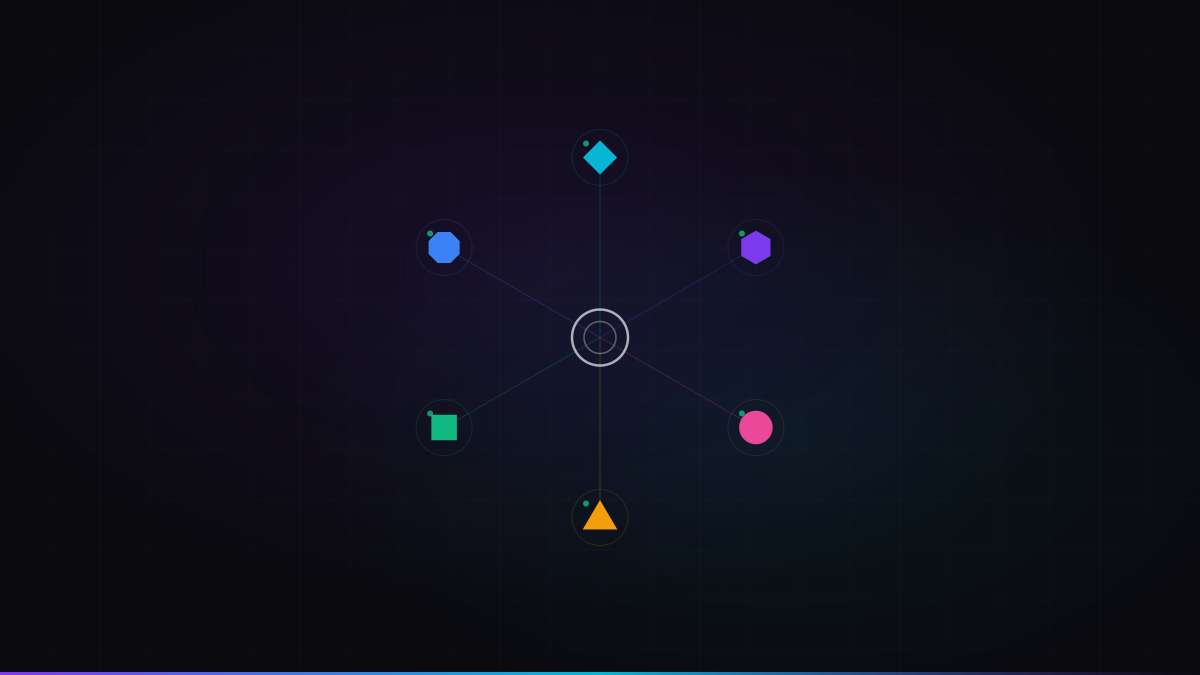
At SMPLDSGN, our agent team looks like this:
Strategist Agent — competitive analysis, market research, positioning, business model evaluation
UX Architect Agent — user flows, information architecture, wireframes, interaction design, accessibility
Visual Designer Agent — brand identity, UI design, visual systems, asset generation
Copywriter Agent — brand voice, conversion copy, SEO content, microcopy
Developer Agent — frontend implementation, CMS integration, automation pipelines, performance
Analyst Agent — analytics, ROI modeling, A/B testing, performance dashboards
The Orchestrator (human) — creative direction, client relationships, strategic judgment, quality assurance
Each agent is specialized. Together, they function like a full-service agency. The key difference: they work in parallel, not sequence.
Why This Matters for Small Businesses
The traditional agency workflow is sequential. Strategy finishes, then hands off to design. Design finishes, then hands off to development. Development finishes, then QA reviews. Each handoff adds days or weeks, and context is lost at every transition.
In an agentic model, agents work simultaneously. While the Strategist is finalizing positioning, the UX Architect is already mapping user flows based on early findings. The Visual Designer and Copywriter work in parallel on design and messaging. The Developer starts building as design components are completed, not after the entire design phase ends.
The result is dramatic:
3x faster delivery — parallel execution collapses the traditional timeline
60-70% cost reduction — no overhead from office space, benefits, project managers managing project managers
Higher consistency — agents do not have off days, forget context between meetings, or misinterpret briefs
24/7 availability — work does not stop at 5pm or pause for holidays
How This Is Different from "Using AI"
Every agency now claims to "use AI." Usually that means their designers use Midjourney, their developers use Copilot, and their strategists ask ChatGPT questions. The humans are still doing the work — AI is just another tool in the drawer.
An agentic agency inverts this. The AI agents are the workforce. They do not assist humans — they execute, with human oversight providing the creative judgment, strategic direction, and quality assurance that AI alone cannot replicate.
This is not a subtle distinction. It is the difference between a factory that gave its workers power drills and a factory that automated the assembly line. The output quality is comparable, but the speed, cost structure, and scalability are fundamentally different.
The Human Question
The most common objection is obvious: "If AI is doing the work, what about the human touch?"
It is a fair question, and the answer is central to how the model works.
AI agents are exceptional at execution — research, iteration, pattern recognition, code generation, data analysis. They can produce a hundred variations in the time it takes a human to produce three.
But they cannot do several things that matter enormously: understand the anxiety behind a client"s brief, make taste-based judgment calls that defy quantification, navigate the politics of a rebrand, or feel the emotional weight of a design choice.
That is what The Orchestrator — the human — handles. Every project is guided by someone who understands the business context, has direct client relationships, and makes the calls that require empathy and creative instinct. The agents handle the what and the how. The human handles the why and the whether.
What This Means for the Future of Agencies
We believe the agentic model is not a novelty — it is the future of professional services. Not just design, but consulting, marketing, development, and any knowledge work that involves coordinated expertise.
The agencies that thrive in the next decade will not be the ones with the most designers. They will be the ones that build the most effective agent systems, with humans focused on the irreplaceable: judgment, relationships, and creative vision.
For small businesses, this shift is unambiguously good news. The same quality of thinking and execution that was previously available only to companies with six-figure agency retainers is now accessible at a price point and timeline that makes sense.
A full agency team. Zero agency overhead. That is not a tagline — it is an operating model.
See It in Action
If you are curious about how the agentic model works in practice, explore our agent team page to see how each agent contributes to a project, or use our comparison tool to see how SMPLDSGN stacks up against traditional agencies for your specific project type.
Or, if you have a project in mind, brief your new team. The Orchestrator will review your challenge and assemble the right agents.
The Orchestrator
Founder & Creative Director
The human in the system. Handles creative judgment, client relationships, quality assurance, and the decisions that require empathy and taste. Every AI agent at SMPLDSGN answers to someone who cares about your business as much as you do.